“A family united in prayer before a meal, honoring God as their Heavenly Father and source of all blessings, is a truly beautiful sight. When the head of the household gives thanks to God for the food, it brings a sacred spirit to the table.” ~ St. John Kronstadt
The dining table is the most sacred icon in the Orthodox faith. There was once a traveling monk spending a few days at a parish. After liturgy, the parishioners bustled about to prepare coffee hour, when someone spotted a broken light. In an instant, a kind fellow climbed up onto a small table to replace the lightbulb. The monk gasped. “Oh no! Please don’t step on the table. Tables are sacred. They are icons of the holy altar.”
The dining table is the holiest object in a house. It is the focal point of a Christian’s life; a place for reverence, communion, and peace. It is the symbol of God’s love for family. It is the Eden given us to guard and protect, where we must nurture seedlings of holiness. We Orthodox Christians love to celebrate the beauty and symbolism of our exotic icons. We would do well to also reconsider the significance of the more basic building blocks of holiness: the family dinner.
“Thou preparest a table before me in the presence of mine enemies: thou anointest my head with oil; my cup runneth over.”
From the beginning, God’s covenant with man was symbolized in the sacred meal spread across the dining table. Thou shalt prepare “a feast of rich food for all peoples,” Isaiah prophecies. “A banquet of aged wine — the best of meats and the finest of wines.” The prophecy was fulfilled in the Holy Eucharist. Agriculture, art, science, and all the poetry of man’s heart raise and ferment crops. We take the fruit of our labor, bread and wine, bring it to God’s table and offer it up. The dew of heaven drops down and changes that bread and wine into the presence of God. “This is my body. This is my blood.” the minister incants. The congregation falls down in adoration. Never forget, the sacrament does not end here. It flows out from the altar into our day to day.
In Orthodoxy, sacred things merge into and transform ordinary things. The sacrament of our Lord’s Supper pours out into all of our food and drink. Every table becomes sacramental. All food shared between Christian people takes on the sweetness of heaven. Every feast day and every coffee hour becomes a participation in our eternal feasting together. The family act of gathering at the dining table, praying, and giving thanks, is the climax of a Christian household.
If the family meal is the symbol of Christianity, modern dining is the symbol of anti-Christianity. Overwhelming studies show that family meals are increasingly rare, the dining table is cluttered, and food is consumed in the midst of interruptions, noise, television, and iPhone scrolling. In such households, children are more likely to have low self esteem, lower grades at school, poor health, increased psychological problems, and a higher likelihood of drug use and social failure.
On the 29th of December, the Church commemorates the Holy Innocents. Two events transpire, one beautiful and the other tragic. The holy family shines in majesty, and the anti-family cries out with ferocity. A child is born and the holy innocents are murdered. Christmas arrives with mirth and wonder. It is a time for feasting together, caroling, and dancing. We bow before the Nativity creche, and we contemplate the holiness of family. In the same breath, the Church reminds us: behold, the anti-family.
“When Herod the king had heard these things, he was troubled, and all Jerusalem with him. And when he had gathered all the chief priests and scribes of the people together, he demanded of them where Christ should be born. And they said unto him, In Bethlehem of Judaea . . . [Herod] was exceeding wroth, and sent forth, and slew all the children that were in Bethlehem.”
God saves us with a baby. The devil lashes out to murder babies. God elevates the family. The world desecrates it.
“In Rama was there a voice heard, lamentation, and weeping, and great mourning, Rachel weeping for her children, and would not be comforted, because they are not.”
Even in the midst of our Christmas jubilee, the Church calls us to be sober. Remember the sacredness of family. Remember the holiness of the dining table.
“A great sign appeared in heaven: a woman clothed with the sun, with the moon under her feet and a crown of twelve stars on her head. She was pregnant and cried out in pain as she was about to give birth. Then another sign appeared in heaven: an enormous red dragon . . . The dragon stood in front of the woman who was about to give birth, so that it might devour her child the moment he was born . . . [and] the woman fled into the wilderness”
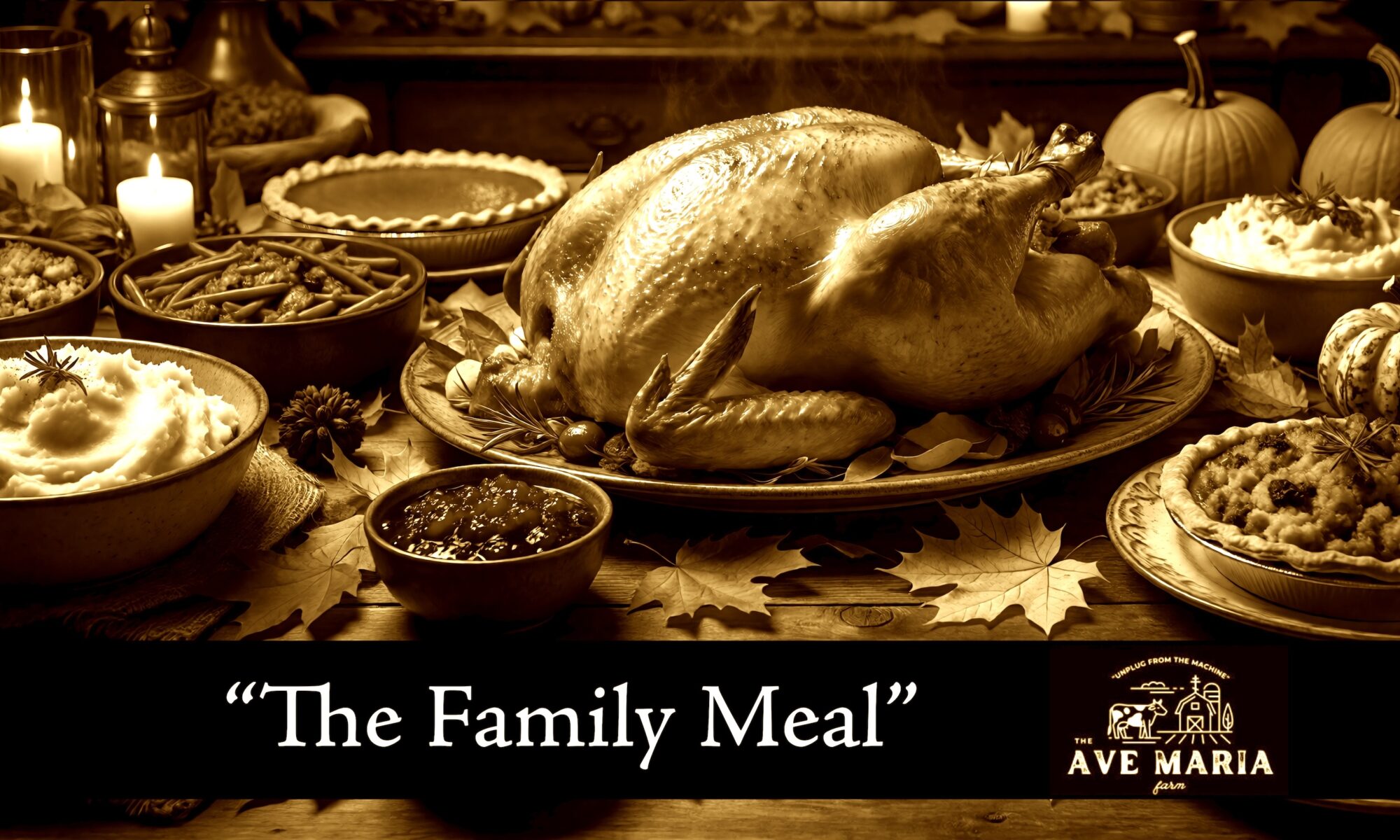
We are in a war. It is a war between good and evil. It is a war between those who hate family life, and those who cherish it. It is a war expressed with such lucidity in the contrast between these two scenes: a peaceful, loving meal, over which a family prays, shares, and reflects, and a disordered, chaotic ‘grazing’ in the blare of TV and frantic texting.
Christmas arrives with a wonderful invocation. Celebrate the simple, old-fashioned things. Return to family meals.
We conquer the devil by celebrating what is good and beautiful. So remember, in the months ahead, this timeless message: the Kingdom of God is at hand with the breaking of bread. The Christian parish and the Christian family are most real and vibrant, when loving souls are dining together and giving thanks.
“There is nothing more pleasant than Divine teaching,” St. John Chrysostom instructs. “Listen to what the prophet says about it: How sweet to my throat are Thy words, more than honey and the honeycomb to my mouth (Ps. 118:103). Put this honeycomb on the evening table, so as to fill all of it with spiritual gladness.”
“When we have returned home, let us offer a double meal—one of food, the other, of [divine teaching]; let the husband pass on what was said, and let the wife learn; let the children also listen . . . let there be offered at your house a spiritual repast together with the bodily one.”
“Sing hymns . . . especially at the table. Since the devil constructs his crafty designs mostly at times of banqueting with the help of intoxication, overeating, indecent laughter and emotional relaxation, it is especially then, and before the meal and after the meal, that one must protect oneself from him with a fence of psalms, and, having risen from the table, together with wife and children, sing holy songs to God.”
Was the monk wrong, who shuddered when a man stepped on a table? There is much to learn from the traditions of old. Our grandparents passed down something sacred, often in little rituals as small and unnoticeable as table manners and family gatherings. Surely, the dining table is the holiest object in our house. It is the place for reverence, communion, and peace. It is our connection with God. It is a return to Eden.